
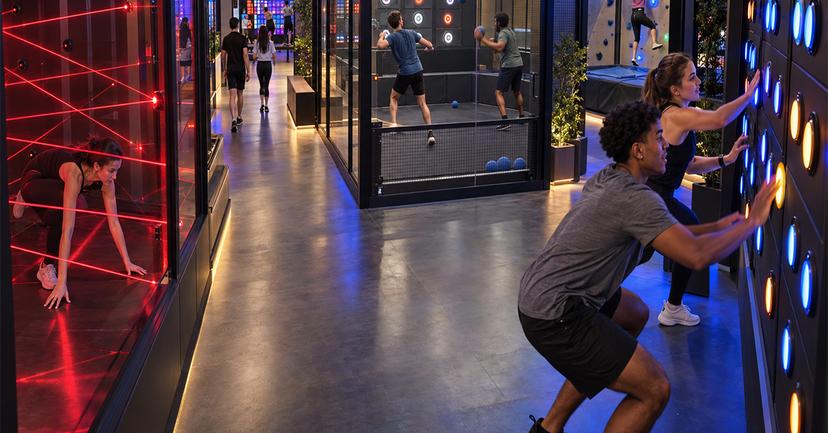
What Is a Commercial-Grade Active Game Room?
A commercial-grade active game room is a technology-enabled physical challenge designed for repeated paid public use. It combines durable construction, responsive detection, stable software, clear instructions, automatic scoring, operator controls, safety features and maintainable components.
For multi-room venues, commercial readiness also requires player identification, unified data, room-to-room progression, leaderboards and central management. A visually exciting room without these supporting systems may be an attraction, but it is not necessarily a scalable active gaming solution.
1. Commercial-Grade Structural Design
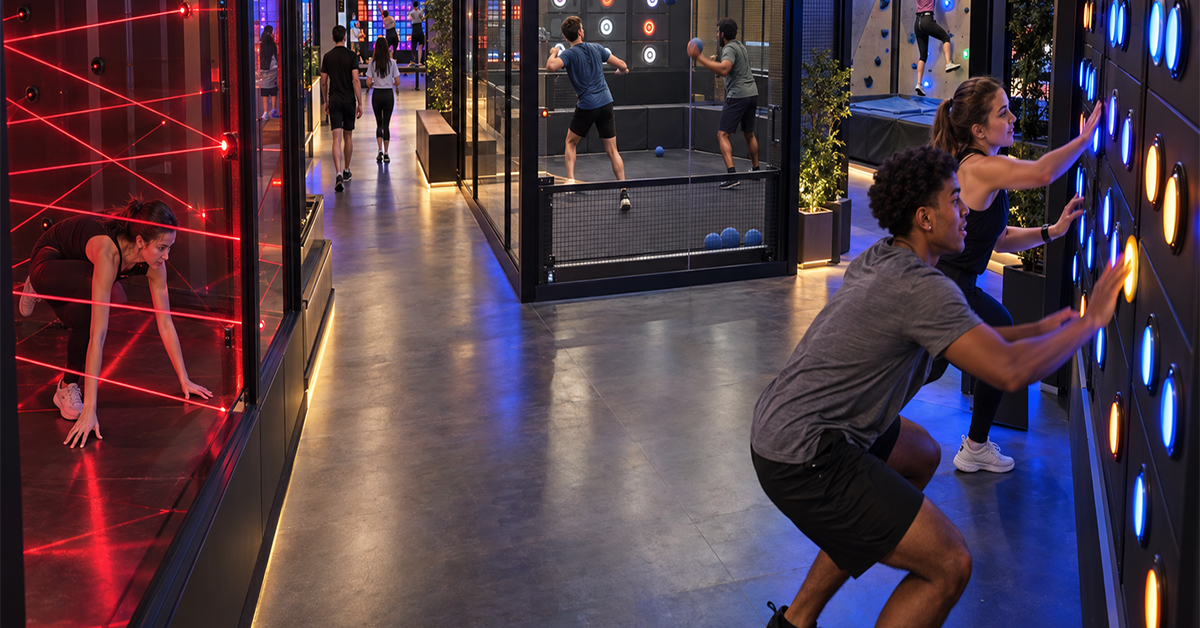
Guests move quickly, touch walls, throw balls and compete under time pressure. The structure must therefore be designed for frequent public use rather than occasional home entertainment.
Investors should check whether contact surfaces are durable, cables and corners are protected, and frequently used parts can be replaced without rebuilding the room. Frames, wall panels, floors and fasteners should suit real player movement and safe circulation. Commercial-grade design means planning for the thousandth game—not only the first demonstration.
2. Accurate Real-Time Detection
Active games may use pressure sensors, infrared beams, illuminated targets, buttons, cameras or position recognition. Whatever the technology, its response must be fast and accurate.
If a guest hits the correct target but receives no score, the game feels unfair. Test multiplayer use, different player heights, changing lighting, long operating periods and the process for replacing or calibrating sensors. A short edited video is not enough; request a live demonstration.
3. Stable PC-Based Room Control
The control system manages game logic, timing, audio, lighting, difficulty and scoring. Staff should be able to start, stop, reset and check a room without complex technical procedures.
Ask whether operators can see room status, change language or difficulty, review fault information and restart one room without interrupting the venue. A commercial room should fail safely and recover predictably.
4. Central Multi-Room Management
When a venue operates several challenges, isolated controllers become inefficient. Staff need a central view of room availability, active sessions, scores and player progression.
A multi-room platform should show which rooms are occupied, available or offline; how long sessions have run; and whether data is being recorded correctly. This becomes more important as a venue grows from six rooms to ten, fourteen or more. More rooms should increase capacity—not uncontrolled complexity.
5. RFID Wristbands and Player Identification
RFID wristbands or player IDs connect physical activity with digital progress. Guests can enter a room, select a challenge, record a result and continue without staff re-entering information.
Integrated identification supports individual and team scoring, game history, memberships, repeat-visit rewards and cross-room progression. Confirm whether RFID is genuinely connected to gameplay or used only for door access. The commercial value comes from linking identity, play and data.
6. Unified Scoring and Leaderboards
Scoring turns physical activity into measurable competition. Leaderboards give guests a reason to improve, compare results and return.
For a multi-room venue, unified scoring creates one player journey instead of unrelated results from separate attractions. Operators can run daily rankings, corporate tournaments, school challenges, birthday competitions and seasonal campaigns. A leaderboard is not simply a screen showing names; it is part of the venue’s retention system.
7. Difficulty Levels and Replayable Content
The room is hardware; the challenge is content. A customer may enjoy the physical environment once, but new missions, faster timing and higher difficulty create reasons to replay.
Commercial active gaming should support multiple modes, levels, target sequences, team formats or updated scoring rules. This is essential for local venues that depend on returning customers.
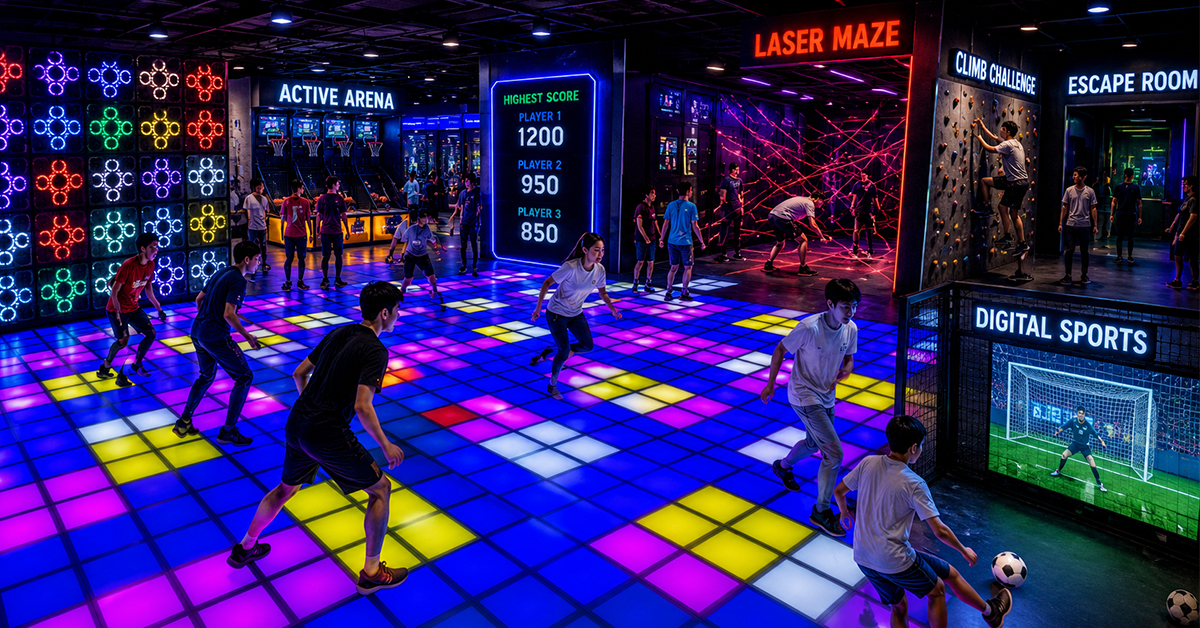
Kydavrplay offers more than 60 active game solutions, including interactive floors, laser challenges, reaction games, sports rooms, climbing activities, skill games, brain challenges and team-based experiences. This enables a varied room mix instead of a venue filled with similar gameplay.
8. Booking, Payment and Session Integration
The guest experience begins before the first game. Booking, payment, waivers, arrival time and team assignment should follow a clear workflow.
The game platform does not always need to replace the booking system, but the integration plan should define how reservations become sessions, how walk-ins are added, how teams are created and when playing time begins and ends. Smooth check-in increases useful playing time and reduces reception pressure.
9. Network Reliability and Offline Operation
Cloud services are useful for reporting, updates and remote support, but investors should ask: What happens if the public internet goes down?
A well-designed venue can keep essential gameplay under local control while synchronizing selected data when internet service returns. Operators should know which functions are local, which require cloud access and how information is recovered. Equipment networks should also be separated from guest Wi-Fi and supported by reliable network hardware.
10. Multilingual Interface and Localization
Commercial equipment should fit its operating market. Localization can include interface language, voice prompts, safety instructions, payment connections and difficulty settings.
Kydavrplay supports Chinese, English, Arabic, French and German interfaces, with project customization discussed according to requirements. Operators should confirm whether language files can be updated and whether tutorials remain clear after translation. Short visual instructions often perform better than long text in a fast-moving attraction.
11. Remote Diagnostics, Spare Parts and Maintenance
Every commercial attraction requires maintenance. The important question is how quickly an operator can identify and solve an issue.
A professional solution should include installation drawings, component identification, inspection guidance, remote support, replaceable-module instructions, recommended spare parts, backup procedures and staff training.
Modular design can reduce downtime because a local team may replace one component instead of waiting for a complete assembly. Confirm support channels, time-zone coverage and spare-parts preparation before opening.
12. White-Label Ownership and Long-Term Control
Investors must understand what they own, what they license and which fees remain after installation.
Ask whether the venue can use its own brand, whether franchise fees or revenue royalties apply, who controls customer information and whether the system can support another location. Software functions, updates, customization and support should be written into the agreement.
Kydavrplay provides factory-direct, white-label active gaming solutions. Operators can build their own brand without paying franchise royalties to Kydavrplay. White-label should mean more than removing a supplier’s logo; it should provide a foundation for an independent entertainment business.
Commercial-Grade Does Not Mean Buying Every Feature
Not every venue needs the same configuration. A six-room escape room upgrade does not require the same integrations as a twenty-room destination center. A compact mall venue may prioritize throughput and self-service, while a corporate venue may prioritize team scoring and event management.
This framework is not intended to make every project more expensive. It helps investors identify essential functions, later upgrades and risks that must be solved before opening.
A responsible supplier should first ask about the country, city, floor plan, audience, group size, ticket model, peak capacity, budget and expansion plan. The correct solution depends on the business—not on the largest available equipment list.
12-Point Active Gaming Equipment Checklist
Before signing a purchase agreement, ask the supplier to demonstrate or document:
Hardware durability and replaceable components
Sensor response during real multiplayer use
Room reset and fault-recovery procedures
Central monitoring for multiple rooms
RFID and player-identification workflow
Score storage and leaderboard functions
Available modes, levels and content updates
Booking, payment and session connections
Internet-failure and offline-operation behavior
Languages and customization method
Remote support, training and spare-parts plan
Branding rights, recurring fees and expansion terms
Do not rely only on promotional videos. Request live demonstrations, interface screenshots, project references and a detailed inclusion list.
Why the Complete System Matters
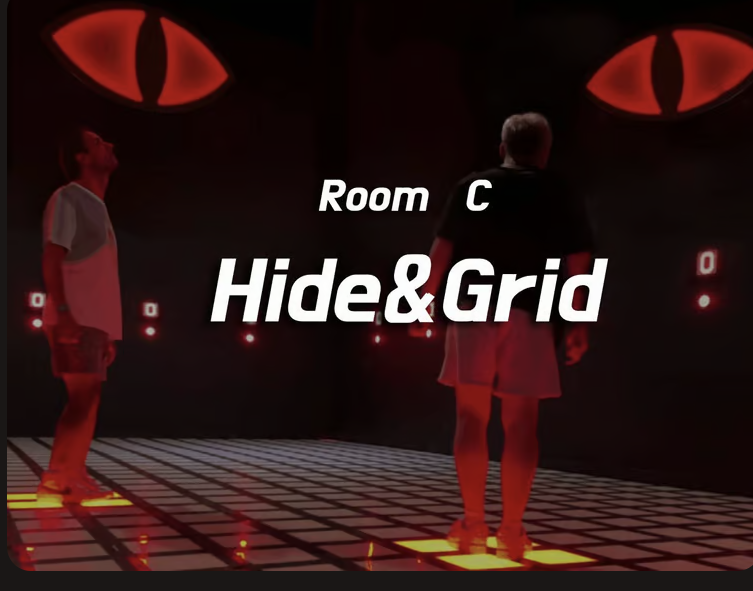
Pixel Grid, Laser Maze, Push, Climb, Arena and Hoops can attract attention, but a sustainable venue is created by the relationship between the rooms.
Players need a smooth journey. Staff need visibility and control. Scores must follow the correct person. Games need variety. Technical teams need clear maintenance procedures. Owners need freedom to develop their brand.
The strongest projects combine four layers:
Physical layer: safe, durable and maintainable rooms
Game layer: responsive challenges with replayable content
Operating layer: identification, scoring and central management
Business layer: brand ownership, localization, support and expansion
Two rooms may look similar in a short video while offering very different commercial value after installation. Suppliers should therefore be compared at the system level.
How Kydavrplay Supports Active Gaming Projects
Kydavrplay is part of Guangzhou Kydavr Tech. Co., Ltd., an active gaming equipment manufacturer and solution provider established in 2016. The company combines software development, hardware development, manufacturing and project support.
With more than 60 active game solutions, Kydavrplay supports FECs, escape room operators, trampoline and adventure parks, mall attractions, corporate venues and entrepreneurs entering active entertainment.
Available functions include PC room control, RFID identification, unified scoring, leaderboards, multi-room management, language customization and game-content updates. Each solution is configured according to venue size, audience and operating model.
The goal is not to copy one famous entertainment brand. It is to help operators create a commercially workable active gaming venue under their own identity.
Final Advice for Investors
Do not choose equipment only because its lights look attractive or one video receives many views. Ask how the system performs on a busy Saturday, how scores move between rooms, how staff diagnose a fault, how challenges are updated and how the venue can expand.
A commercial-grade active game room must be exciting for guests and manageable for operators. When hardware, software, content and operations work together, active gaming becomes a repeatable platform for group events, memberships, tournaments and long-term brand development.
Frequently Asked Questions
What is the difference between an active game room and a commercial-grade active game room?
An active game room provides a physical interactive challenge. A commercial-grade room adds the durability, detection accuracy, stable software, scoring, safety, maintenance and controls required for repeated paid public use. Multi-room venues also need player identification and central management.
What should investors check before buying active gaming equipment?
Investors should evaluate construction, sensors, software, room control, RFID, scoring, content depth, network design, localization, maintenance and ownership. Live demonstrations and a written inclusion list are more reliable than promotional videos alone.
Can Kydavrplay equipment operate under the venue owner’s brand?
Yes. Kydavrplay provides white-label solutions that let operators develop their own identity without paying franchise royalties to Kydavrplay. Branding, software functions, updates and support should be confirmed in the project agreement.
Why are game updates important?
Updates can add challenges, difficulty levels, seasonal content and operational improvements without rebuilding the physical room. This maintains replay value and gives returning customers new goals.
How many active game solutions does Kydavrplay offer?
Kydavrplay offers more than 60 active game solutions across interactive floors, laser games, reaction challenges, sports rooms, climbing activities, skill games, brain challenges and team-based experiences.
Plan Your Active Gaming Project
Planning a new active gaming center or upgrading an existing FEC, escape room or indoor playground?
Send Kydavrplay your country, city, floor plan, target audience, expected opening date and approximate budget. Our team can recommend a preliminary room mix and discuss hardware, software, RFID, scoring, localization and white-label requirements.
Contact Kydavrplay to request a commercial active gaming solution for your venue.